This post is intended to be read as part of an interactive project, this is the backup in case you can't or don't want to be bothered, but I'd encourage you to try it out first ^.^
A guest submission for the August 2026 Midway Menagerie, on the theme "Where is furry?"
Where is Furry?
The Passing Lane
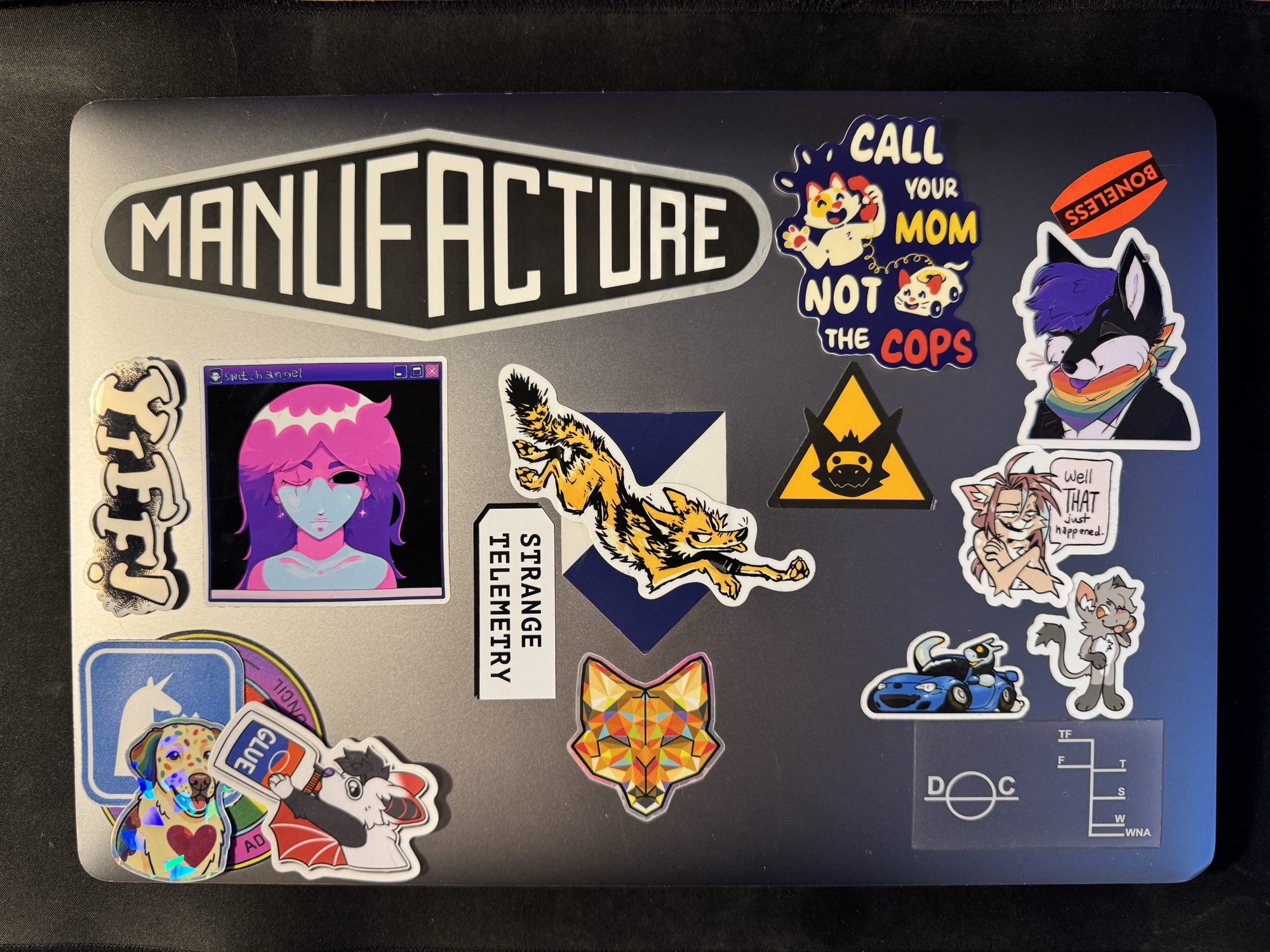
My car is covered in furry stickers and nearly all of them are magnets.
I tell myself I enjoy change and like swapping them out and moving them around, which is true, but if I'm being honest I also like the impermanence. I like that I can assert a possibility while moving through the world, and I like that I can fly under the radar when I want to. I like that I can make people laugh in traffic and also peel them off and choose not to get tailgated by MAGA trucks. I get to choose to make space for my fellow freaks in public but also I can choose to stash it when inconvenient.
To some extent I experience something similar with regards to my own gender and sexuality: as a polyamorous-pansexual-genderqueer person whose most visible relationship conveniently appears to be "straight", I often have the luxury of passing. Most people use he/him pronouns on me and I let that go. Many devalue my "secondary relationships" if they're even aware. Most establish the shape of something they recognize and are comfortable with and never inquire further.
I could of course assert otherwise, and in some cases I do, but most of the time it's simply easier not to engage, to slip out the side door. I tell myself the important people know and that it's often not worth the energy. I am tired and I want a beer. I might even want it in a bowl. But truly: I do not wish to explain gender (or species dysphoria) to you right now. I am not going to apologize for my friends. I am pointedly ignoring your slightly confused expression and your unasked questions. Yes, sometimes I use different names. No, I'm not upset you called me ma'am.
There are complicating factors: I'm white, my primary partner isn't. She has been mistaken as the nanny at our kid's school before. Our kiddo is non-binary and I advocate for them. Many of my friends are trans and their ability to pass (or not pass) as their chosen gender is a complex, fraught and sometimes harrowing experience. I'm dedicated to making the world as smooth as possible for them; I don't want to trip anyone up.
What right do I have to trouble the waters with my own existence?
A relative versed in formal etiquette addressed an invitation mailed to my house (intended for my partner) as "Mrs. [My Legal First Name] [My Biological Father's Last Name]" and I stared at it dumbfounded for several minutes, not recognizing who it was meant for.
Marked Territory
It always surprises me how little space the stickers take up when I peel them off, stacked neatly in the corner of the glovebox out of view.
The fact that I can do any of this is, to be sure, a privilege. The fact that I largely experience this privilege as painful changes nothing: it gives me an edge over my peers who are more visibly other. This itself can cause an anxiety loop: am I queer enough? Am I performing enough? Too much? Maybe I shouldn't wear that. Maybe I can't wear that.
Worst of all are the handful of times — small in number, deeply hurtful — I've been "called out" by peers for not understanding what it's like since I'm "so obviously a rich white straight dude." It's seared into my brain. I want to yell that I'm none of these things and yet the fact they see it that way is an advantage of sorts. I bite my tongue and nod "You're right. I'm sorry. I'll do better." We move on.
What I'm describing is navigating what Deborah Tannen describes as "markedness," which is to say the state of having a default from which "other" things depart. Defaults are useful, this is not always a moral complication. Tannen borrows this idea from linguistics: we say "visit-ed" to mean the past-tense of visit. Visit is unmarked, visited is marked. Similarly we do this with plurals: we add "s" to mark that a box of spoons contains more than one, unmarked the word is just "spoon."
We also use lexical markers: "black scientist," "white rapper," "male nurse," "female executive," "furry artist."
The trouble isn't markedness itself or the existence of a default mode, it's the unexamined choice of which language we use as default. This almost always reflects the values and features of the majority culture. Inherently we create a hierarchy, working into our language and communication the category of "other" and "not normal" even in everyday speech. This is particularly noticeable in English, which lacks grammatical gender, and yet we continually assert it anyway. Cartoon creatures are generally male unless specified otherwise, boats are female. Digital Assistants were notably all female until they became extremely valuable to certain people. Now that they've been upgraded to "AI," feminine names have been mostly replaced with masculine or harder-edged mechanical sounds: serious names for serious problems.
What this does is to constantly re-affirm that those things which are not the default are remarkable, different and perhaps strange. We say "black scientist" because we are asserting that blackness is the most notable characteristic of the scientist. We say "female executive" to draw attention to the remarkable notion that a woman could hold a position of power. We say "female gamer" to assert a category different from "gamer" although the data shows there's a fairly balanced gender split among people who play games across all ages.
With these markers come a raft of unspoken but potentially corrosive value judgments. As Tannen writes, "gender markers [in particular] pick up extra meanings that reflect common association with the female gender: not quite serious, often sexual."
On this last point, I'll posit something both personal and strange: this gendered, often sexual, extra meaning goes a long way to explaining why I almost always prefer gender neutral pronouns, but in pup headspace, I strongly prefer being referred to as "good girl" (or "good boy"). The gesture of gendering here is a type of linguistic bondage, an assertion in the context of play, but it's a role offered as an interrogative. "This is what you want, yes?" rather than "This is what I see."
The interrogative move is crucial to both the community and what's happening here: the rules of play involve mutual negotiation. Do I need to assert myself? Do I need to trouble the waters? Do I need to terraform the environment to suit my identity? Not when the invitation is extended. Nothing needs troubling here because nothing has settled.
So here we circle back to what I value most about the furry fandom: the assertion that these choices sit with each individual and that far from being an abnormal or "pre-real" state, playfulness and malleability are the natural state of things. The boundaries are porous. In this way furry flips the script.
Border Crossing
The stickers stack flat and travel with me, across miles of road, red and blue states, border crossings and rest stops and campgrounds and on into the parking garage of a con hotel. They're no different, the same set, but the context has changed.
Outside, on the highway, the stickers on my car mark an assertion against the world. An invitation to challenge. Inside the parking garage the stickers are at best a marker of inclusion for the event, but just as likely a neutral gesture. Other cars have far more, the notability is softened, the impact matters less.
Thus, while markedness is, in Tannen's description and within the broader cultural context, largely injurious, in the fandom context it's the boundary marker that makes the play possible. The apparent white 20-something 150lb dude in front of me is a 300-year-old, two-ton female dragon from space. I know because I asked and I accepted the answer.
A feral animal (previously domestic, distinct from wild) does not necessarily experience itself as feral — the label belongs to the enclosure. What is unique about furry play is that it is simultaneously everywhere and nowhere at all: it is a special weekend, an image board, a genre tag. It is also an approach to life, a way of thinking, a deliberate stance. Furry does not begin with the notion that it will be "anti-normie" but it effectively de-fangs the normalizing function of markedness by grasping the otherness and turning it into a boundary of play.
External to the fandom, furry is a marker: a descriptor of an aesthetic, a behavior or a costume. It is a modifier applied to an otherwise "normal" event. Most often it is simply synonymous with "fursuiter." Although frustrating, this shouldn't be surprising: fursuits are the most visible marker of our subculture and they operate directly on and often challenge the most basic things that we typically use as markers in "everyday" life: our skin color, height, gender presentation and body shape.
From an outside perspective, then, furry becomes synonymous with fashion, as punk did in the 70s and 80s. Unlike punk, the specificity and total "weirdness" of furry costume strongly resist commercial exploitation not because it is difficult to copy (it isn't) but because it is nearly illegible without immersion in the community. Anyone can manufacture fuzzy ears, but the fact that blue-striped ears with pink tips indicate your friend (and only your friend) encodes commitment to culture. The markers are present and visible to all, but illegible unless you know how to read them.
Punk-as-fashion entwined itself with commerce almost from day one. Malcolm McLaren and Vivienne Westwood opened their boutique Sex in 1974; McLaren was simultaneously selling the clothes and managing the bands that wore them. This is not to say punk itself was ever "merely" fashion — only that the fashion arrived early, and arrived for sale.
Both furry and punk produce an aesthetic that is "other," but punk-as-fashion selects its otherness with a curator's eye: reproducible mirror-image versions of whatever is mainstream. This is why it borrows so freely from BDSM and kink — not because it shares anything with them, but because it counts on them to upset.
Punk-as-fashion might select a dog collar — cheap, aggressive, binding — as a mockery of mainstream fashion or in a bid to upset the dominant idea of what is publicly acceptable. Kink (and furry) wears the same collar not because they want to "squick the normies," but because a collar feels exactly right.
Actual punk does something else, as do kink and furry: they rarely begin from an anti-stance at all. They assert something wholly apart and then decline to be overly concerned with the default culture's reaction. This is a gesture I'd call feral — not wild, which was never domesticated, and not tame, which never left. Feral is what happens when something previously kept in an enclosure walks off and keeps on going.
As furry gains traction in the mainstream, as we all get older, as cons explode in size and scope, it's worth noting the relationship of the subculture to commerce, and nowhere can we see the future more clearly than in the state of virtual worlds (a different "where" of furry, where many of the community gather when they are not together in real life).
The software companies that host these venues are increasingly struggling financially, imagining themselves to be the equivalent of Sex, laying claim to the subculture which just happens to mingle there. These boutiques attempt to support themselves on hyperscaled commercial sales of commodity items to a community whose economy is the collective celebration of the opposite. This will forever fail as it traces the shape of a fundamental misunderstanding: the gap between marker as boundary and marker as choice.
Someday Marriott might fund their operations by selling off-the-rack fursuits for con attendees at the door. Probably not.
Where is furry? It's everywhere. And also, in carefully marked spaces containing the like-minded. Furry is both an identity and a performance, in equal measure and with choice. Furry is both marked and unmarked: a furry weekend, a furry dance party, a furry themed drink. It's also dinner with friends who happen to have the same sensibility, home with housemates who don't mind your preoccupation with Pokémon. It's a portable stance which folds flat, can be performed, held close, shared as I wish, or not at all. Furry is wherever markedness is voluntary — wherever the invitation is extended.
What right do I have to trouble the waters with my own existence? This is the wrong question. The right one was always: "This is what you want, yes?"
Hi, my name is An. I'm always fox.